Berklee C.O.M.
Modulated Short Delay Effects
How they FUNCTION...


Flanger
Because of the very short delay times in flanging, the resultant phase
creates a metallic and ripping effect that some compared to the sound of a jet taking off.
LFO
A low-frequency oscillator (LFO) is a time-variant controller that can induce change in an oscillator, filter or amplifier, depending on which module is the destination of an LFO control signal.
It produces a low-frequency waveform (generally sinusoidal, triangular, rectangular, sawtooth or others), it is often in the range below 10 Hz , therefore it is inaudible.
In addition to the controls mentioned in the Delay Effect refresher, with Flanger we also have:
-
Envelope section is used for periodic control of delay time.
-
Attack and Release controls define envelope shape.
-
Hi Pass cuts low frequencies from the delayed signal
-
LFOs have 6 possible waveform shapes: sine, square, triangle, sawtooth up, sawtooth down and random.
-
Amount control sets the extent of LFO influence on the delays.
-
Rate control defines LFO speed and can be set in hertz or notes.
-
Phase control offsets LFO's waveforms relative to each other.
Phaser
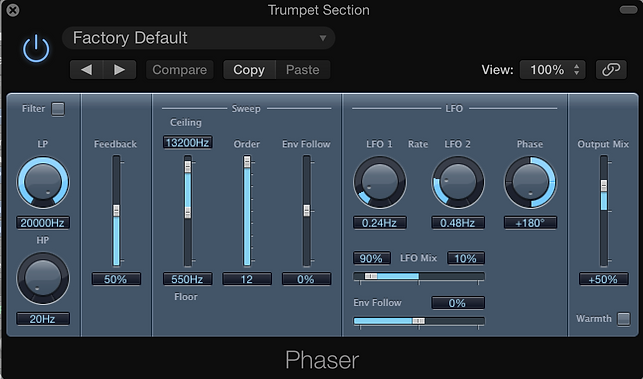
A phaser is an electronic sound processor used to filter a signal by creating a series of peaks and troughs in the frequency spectrum. The position of the peaks and troughs is typically modulated so that they vary over time, creating a sweeping effect. For this purpose, phasers usually include an LFO.
Phasing effect is created by splitting an audio signal into two paths. One path treats the signal with an all-pass filter, which preserves the amplitude of the original signal and alters the phase. The amount of change in phase depends on the frequency.
When signals from the two paths are mixed, the frequencies that are out of phase will cancel each other out, creating the phaser's characteristic notches. Changing the mix ratio changes the depth of the notches; the deepest notches occur when the mix ratio is 50%.
Phaser Structure
Usually phasers use a series of variable all-pass phase-shift networks which alter the phases of the different frequency components in the signal. These networks pass all frequencies at equal volume, introducing only phase change to the signal.
Our ears are not very responsive to phase differences, but this creates audible interferences when mixed back with the dry (unprocessed) signal, creating notches.
In addition, the output can be fed back to the input for a more intense effect, creating a resonant effect by emphasizing frequencies between notches. This involves feeding the output of the all-pass filter chain back to the input:
Common controls
-
Poles Parameter: is the total number of all-pass filters in the array. It determines the overall spectral intensity of the effect. That is, lower amounts create subtle animation, while larger amounts introduce the “whooshing” sound. Poles control creates notches in the frequency spectrum.
-
Poles Frequency ("center frequency"): controls changes filter cutoff frequency. This parameter varies the phaser’s response toward the lows, mids or highs.
-
Earth/Space control: changes the spacing of notches along the spectrum between classic (earth) and metallic (space). This effect can be further adjusted with Color control.
Phaser effect is created by mixing the original signal with another version of itself which has been phase-shifted.
Flanger effect is a specific type of phasing which uses notches that are "harmonically related", i.e. related to musical notes.

Flanger sample
Chorus sample
Star Trek Movie Phaser Effects
Listen to these -
Top Ten CHORUS effect recordings