
An envelope in musical sound, is the attack, sustain, decay and release of a sound.
Attack transients consist of changes occurring before the sound reaches its steady-state intensity.
Sustain refers to the steady state of a sound at its maximum intensity, and decay is the rate at which it fades to silence. In the context of electronically synthesized sound, the term decay is sometimes used to refer to a drop in intensity that may occur between the attack and the sustain phase, and in such cases the time it takes for the sound to fade to silence is called the release.
Envelope, the combination of the three components of a dynamic musical tone, is an important element of timbre, the distinctive quality, or tone colour, of a sound. Every musical instrument has its characteristic attack, sustain, and decay pattern. Attack transients are very complex and difficult to characterize because of the speed with which the character of a sound changes in its first few milliseconds, and they have been the subject of research into exactly how they affect the tone quality of musical instruments. An envelope is a specific modulator attatched to the VCA (amp).
Envelopes
ADSR Explained
ADSR Envelope INSIDE Sythesizer Part b
ADSR Envelope INSIDE Sythesizer Part A


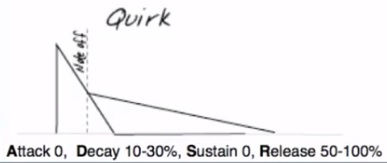

Types of envelopes
USES of envelopes
ADSR envelopes can be thought of as maps for automatic knob control. They are often used to control the volume of a sound, although they can be used to control almost anything inside a modular synthesizer. For example, the same envelope could control a resonant low pass filter, making a cool sweeping and wooshing effect evolve as we play each note.
More advanced envelope generators provide more segments, allowing more complicated volume envelopes to be produced; the ultimate in this area can be seen in some of the newer soft synths which provide envelope generators with hundreds of segments, not to mention the universal event generator. In addition to volume, the output of an envelope generator is often sent to a voltage controlled filter to produce a timbre contour, or mixed with the control voltage input to a voltage controlled oscillator to produce a frequency contour.
Attack
Fast attack
The closer the attack of a sound (A) is to the peak (B) of a sound, the faster its attack is.
Sounds that have a fast attack are..
-
gunshots
-
slaps
-
door slams
Slow attack
Sounds that have a slow attack take longer to build to the sustain level.
Sounds that have a slow attack are…
-
a dog's short warning growl prior to bark
-
stepping on a dry leaf
-
slowly tearing a sheet of paper
-
closing a door slowly
-
an entire thunderclap
The actual time it takes for a sound to diminish to silence is the decay time.
How gradual this sound decays is its rate of decay.
Listening to a sound tells the listener if it is...
Indoors (small enclosed area with a great deal of absorbency)
-
little decay and with very little or no reverberation
Outdoors (open unconfined area)
-
long decay with an echo
The end of a sound is often referred to as the "tail" of a sound, and conversely, the beginning of a sound is its "head"
- Whenever you are editing a sound, you must allow enough room at the tail for fade.
Decay
First time using Retro Synth in Logic Pro X.
You can see and hear the effects.