
Week 4:
Dynamics Processors
Main Parameters of
Dynamic Processors
RMS is an average level of what’s going on in that signal. We then control the volume fader using it.
When we are programming we need two parameters.
At what point do we start bringing down the level: this is the Threshold.
The Ratio: is how much it comes down.
You must adjust the threshold based on the input signal.
Also how fast the fader moves...
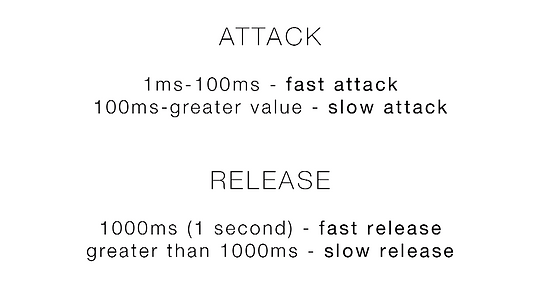
This is going to be the Attack and Release parameters.
E.g. Increasing Attack time allows the Transient to come through, the initial hit of sound. Attack time is usually kept very low.
Increasing Release – changes how long the sound takes to come back up.
The Auto Gain section should not be on, you should MANUALLY adjust the dynamics.
Ratio (Input: Output)
Release (ms)
Threshold (dB)
Attack (ms)


 Ratio 1:1 |
|---|
 Ratio 2:1 |
 Ratio 4:1 |
 Ratio 10:1 |
Summary
Threshold (point at which the dynamic effect starts to function)
Ratio (how much it functions when it crosses the threshold)
Attack (how fast the fader moves or the volume will change at the beginning of the sound when the sound crosses the threshold)
Release (how fast the fader moves or volume changes when the signal crosses back through the threshold)
Increasing Attack time allows the Transient to come through, the initial hit of sound. Attack time is usually kept very low.
Attack flattens or sharpens the first hit point/Transient
Increasing attack leaves a swell sound so needs to be adjusted perfectly.
Increasing Release – changes how long the sound takes to come back up.
With Release too high: the gate never brings the level down fast enough and we can hear those extra noises after the hit.


